What is ERP?
What is ERP?
Enterprise Resource Planning (ERP) is a software that is built to organizations belonging to different industrial sectors, regardless of their size and strength. Contact us Now for ERP Training in Jayanagar Bangalore.
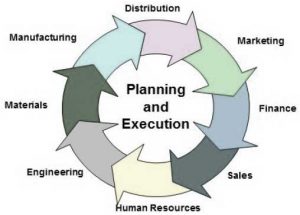
The ERP package is designed to support and integrate almost every functional area of a business process such as procurement of goods and services, sale and distribution, finance, accountings, human resource, manufacturing, production planning, logistics & warehouse management.
Functional Areas
ERP is a business management software is usually a suite of integrated applications that a company can use to collect, store, manage, and interpret data from many functional areas including −
- Financial Accounting− Deals with financial transactions and data.
- Human Resource− Deals with information related to employee of an organization.
- Customer Relationship Management− Deals with capturing and managing customer’s relationship, facilitating the use of customer experience to evaluate the knowledge database.
- Sales and Distribution− Deals with order placement, delivery, shipment and invoicing.
- Logistics and Warehouse Management− Deals with storage of products and shipment.
- Manufacturing and Material Management− Deals with the production and production planning activities.
- Supply Change Management− Deals with the movement of products, storing, managing, and controlling supplies.
- Business Intelligence− Analyzes data and converts the same to information.
Contact us Now for ERP Classes in Jayanagar Bangalore.
Advantages of ERP
By integrating the business processes, the ERP offers the following advantages −
- Saves time and expenses.
- Allows faster decision-making by the management, utilizing the data and reporting tools designed in the systems.
- Single data source and sharing of data among all the units of an organization.
- Helps in tracking every transaction that takes place in an organization, from starting till end.
- Supplies real-time information whenever required.
- Provides synchronized information transfer in between different functional areas such
- as sales, marketing, finance, manufacturing, human resource, logistics, etc.
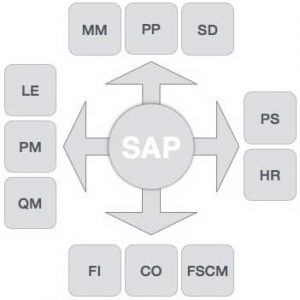
solutions include a number of functional modules, which support transactions to execute key business processes, such as −
- Financial Accounting (FI)
- Controlling (CO)
- Materials Management (MM)
- Sales and Distribution (SD)
- Logistics Execution (LE)
- Production Planning (PP)
- Quality Management (QM)
- Plant Maintenance (PM)
- Project System (PS)
- Human Resources (HR)
- ABAP Technical
- BI
Finance and Controlling (FICO)
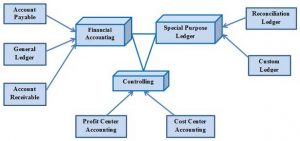
SAP FICO is a combination of two ERP modules, i.e., Finance Accounting (FI) and Controlling (CO). Under Finance in SAP and at an enterprise level, the following modules take part −
- FI − Finance
- CO − Controlling
Erp SAP FI (Financial Accounting) is accountable for tracking the flow of financial data across the organization in a controlled manner and integrating all the information for effective strategic decision-making.
Activities Involved in SAP FI
- Creation of Organizational Structure (Defining Company, Company Codes, business Areas, Functional Areas, Credit Control, Assignment of Company Codes to Credit Controls)
- Financial Accounting Global Settings (Maintenance of Fiscal Year, Posting Periods, defining Document types, posting keys, Number ranges for documents)
- General Ledger Accounting (Creation of Chart of Accounts, Account groups, defining data transfer rules, creation of General Ledger Account)
- Tax Configuration & Creation and Maintenance of House of Banks
- Account Payables (Creation of Vendor Master data and vendor-related finance attributes like account groups and payment terms)
- Account Receivables (Creation of Customer Master data and customer-related finance attributes like account groups and payment terms
- Asset Accounting
- Integration with SD and MM
ERP SAP CO (Controlling) module facilitates coordinating, monitoring, and optimizing all the processes in an organization. It controls the business flow in an organization. This module helps in analyzing the actual figures with the planned data and in planning business strategies.
Two kinds of elements are managed in CO −
- Primary Cost elements
- Revenue cost elements
These elements are stored in the FI module.
Activities Involved in ERP SAP CO
- Cost Element Accounting (Overview of the costs and revenues that occur in an organization)
- Cost Center Accounting
- Activity-Based-Accounting (Analyzes cross-departmental business processes)
- Internal Orders
- Product Cost Controlling (Calculates the costs that occur during the manufacture of a product or provision of a service)
- Profitability Analysis (Analyzes the profit or loss of an organization by individual market segments)
- Profit Center Accounting (Evaluates the profit or loss of individual, independent areas within an organization)